
Own the City: The Case for Artist-Led Development
A pitch deck for a new cultural development in Atlanta did the rounds last year. For most of its slides it looked like any other mixed-use scheme: retail, residential, a venue, and renderings full of people enjoying themselves. Then came a slide with a single photo of Ludacris, listed as part of the development team, and the whole project read differently.
If one name on one slide can change how industry insiders see a project, it's worth asking what real artist involvement could do for investors, audiences, local communities and the long-term value of a development.
More than a Face on a Flyer
Artists have been lending their names to fashion labels, energy drinks and cars for decades. Real estate has mostly kept them at arm's length. When they do turn up, it's usually to cut a ribbon, supply a quote for the press release or play a short residency around the opening.
That is starting to change. A growing number of artists are putting in capital, sitting in design meetings and helping write the brief from day one. They're drawing on years of experience in other people's buildings to shape how new cultural spaces get built and run.
Artists have always performed in cities, and plenty have endorsed them. Now some are starting to own pieces of them. Ownership comes with creative authority, a financial stake and a reason to stick around, which is a very different arrangement from a sponsorship deal.
The Barclays Center shows the limits of the old model. Jay-Z opened the arena with a multi-night residency and became its public face, giving it a cultural authority no marketing campaign could have delivered. But his stake was a fraction of a percent, he sold it within a year, and he moved on. An endorsement lasts for a moment, while an investment keeps an artist involved for years. The smartest artists increasingly know which one they want.
The US Leads the Way
Across the US, artists are no longer waiting to be approached as tenants or brand ambassadors. They're arriving as investors and co-creators, and in some cases they're the ones driving major urban projects.
In Atlanta, Centennial Yards is a $5 billion scheme turning the long-derelict Gulch into homes, hotels, shops and entertainment space. Usher, 2 Chainz and Killer Mike are all investors. Their involvement changes the conversation in the room, because they know the city's audiences, its cultural dynamics and where the community sensitivities lie. That kind of knowledge is hard to buy. Live Nation has signed on to operate the planned 5,300-seat venue, and for promoters and touring artists, those names are a sign the place has credibility from the inside.
In Shreveport, Louisiana, 50 Cent has committed $124 million to turning downtown into a hub for film, music and live entertainment. The plan covers a renovated venue, an upgraded production campus and a new immersive venue that he will own outright. Two of the three properties had sat empty for years, passed over by conventional developers. He saw infrastructure the industry needed and decided to build it himself, in a city he believes in.
Hollywood has its own examples. Grammy-winning producer Philip Lawrence is leading a $500 million cultural campus on Sunset Boulevard, combining recording studios, performance space and a pipeline into local performing arts education. Around the same time, John Mayer bought the historic Chaplin Studios lot and committed to keeping it a working space for the creative community.
The scale and approach vary, but the instinct is the same: instead of waiting for someone else to build the infrastructure, these artists are building it themselves.
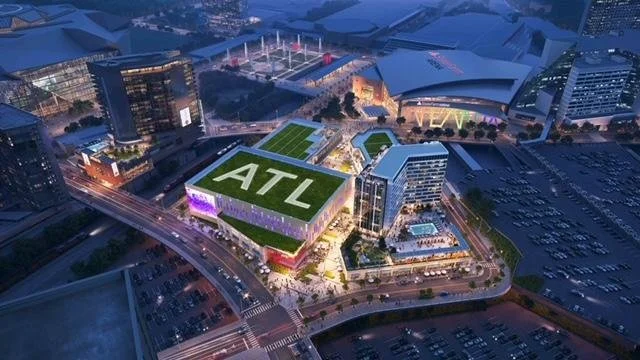
Image: Centennial Yards Atlanta
The UK Proof of Concept
The UK has been slower to take up artist-led development, but it has one standout example.
While still touring with Mumford & Sons, Ben Lovett opened Omeara near London Bridge. It's a 325-capacity venue designed around what he'd learned from playing more than a thousand venues around the world. Every detail was considered, from acoustics, sightlines and green rooms to fair deals for artists and a space that feels exciting to walk into.
His company, TVG, has since gone further. The Orion Amphitheater in Huntsville, Alabama, is an 8,000-capacity outdoor venue widely praised for the audience experience, and its backers include Irving Azoff. "You have to put the artist and the fan at the centre of every thought process," Azoff has said. "That's the key, and TVG are both artists and fans."
The stage and architecture at The Orion are impressive, but the backstage is what stands out. The green rooms, the load-in and the loading bays all reflect people who have played in poorly equipped venues and know what performers actually need. On a site visit, TVG partner Ryan Murphy spent more time on loading bays and backstage areas than on anything front of house, which says a lot about why the venue works.
Montreal: The Radical Experiment
Montreal is asking bolder questions still. The Rent Free Coalition, a partnership of artists, cultural entrepreneurs and urban developers, starts from a simple premise: what if artists became the developers? Its argument is that artists are essential workers, on a par with teachers and healthcare staff, and that cities should be organised to reflect that.
Rather than leaving artists at the mercy of the property market, the coalition wants to put them at the centre of it. The ambition goes well beyond entertainment districts to the wider fabric of the city. Artists tend to understand how neighbourhoods actually work: how communities move, where culture gathers and what keeps a creative scene alive.
The For/By Principle
Not every artist-led project lands. Pharrell Williams and designer Nigo are creating Japa Valley Tokyo, a 10,000 square metre pop-up district of art, retail and hospitality modelled on California's Napa Valley. It's an interesting idea on paper, but the tension between cultural ambition and commercial scaffolding is hard to miss.
The difference comes down to authenticity. Centennial Yards, The Orion and Omeara work because they're made for artists and by artists. Projects struggle when the celebrity involvement looks like branding added on top rather than real co-creation, and communities can tell.
Spaces work best when the people who'll use them help shape them. That means more than signing off a mood board or a colour palette. It means real input into the brief, the design, the programming and how the place is run over the long term.
Artists read spaces in ways developers often can't. They know how a room feels half-full compared with packed. They know why green rooms and load-in matter, how crowds move, and how a long wait at the cloakroom can sour an otherwise great night. That's practical expertise that affects how a venue runs, not just how it looks.
The commercial case
For developers and investors, the argument is financial as well as cultural. A credible artist partner brings an audience, a network, taste and legitimacy, and that influence grows over time in a way a marketing budget can't match. Jay-Z's Barclays residency made headlines for a season, while Lovett's work on Omeara and The Orion produced venues that are still earning their reputations.
Artists attract other artists, and they bring in promoters. Their feel for programming feeds straight into a venue's commercial performance. Cultural credibility is hard to fake and easy to lose, but once a venue has earned it, it tends to last.
The opportunity
The trend is gathering pace. When artists are embedded in the development process with real authority and a real stake, the spaces tend to perform better. Communities notice, and the returns show it.
The appetite is there on both sides of the Atlantic, and the examples are already built. What's less certain is whether developers and cities are ready to give artists a real seat at the table, one that comes with decisions and not just an invitation to opening night.
Some of these projects will stumble. But artists have spent their careers reading rooms and working out what makes a space feel alive, and they're no longer waiting to be asked in. The right artist partner brings far more than a name: a community, credibility and a personal stake in the outcome. When an artist owns part of a place, its success is their success too, and that's a strong reason for cities and developers to start listening.
